
Category: Security
PirateBrowser Reaches 100,000 Downloads In 3 Days
 It seems like the release of PirateBrowser has made quite a splash in the tech community.
According to the recent report, the anti-censorship browser by ThePirateBay has been downloaded over 100,000 times and that’s just in the last 72 hours.
For those interested in the PirateBrowser, it should be noted that it only combats censorship and does not actually make the Internet experience fully anonymous.
Tip: Generate Fake Emails And Credit Card Numbers With MaskMe
 Now here’s something awesome.
If you don’t feel like entering your real email or phone number when signing up with some (especially dodgy) web site, then MaskMe is the extension you’ve been waiting for.
Here’s how it works:
When you install the add-on and signup on any new website, it will allow you to generate “fake email” address, which then will forward confirmation link (or any other information) to your real inbox. The result? You real email address won’t be sold to email marketers and when you do start receiving spam, you can delete the fake one at any time.
Continue Reading
Extracting Your Passwords From Google Chrome Is As Easy As ABC
 Took us five years to figure that out.
Now here’s something that you wouldn’t expect from the 1st class software. According to Elliott Kember, the software develoepr and director at Riot, Google does an absolutely horrible job at protecting your sensitive data.
As it turns out, extracting your Google Chrome passwords is so easy, it’s actually mind boggling. All you have to do is type chrome://settings/passwords in the URL bar and that’s it. There are no master passwords, security prompts or anything of that nature.
Continue Reading
Privacy Protection: Internet Explorer & Safari Lead The Way
Time to switch or is it?
It’s been a while since the last NSS Labs report and as it turns out, instead of comparing malware block rates like they always do, the guys have decided to do something different: find out which browser has the best built in privacy protection.
As it turns out, Safari and Internet Explorer users are protected better than those of Chrome and Firefox (if we ignore 3rd party extensions and NSA) and here is why:
Continue Reading
Microsoft: We Are More Secure Than Google & Mozilla
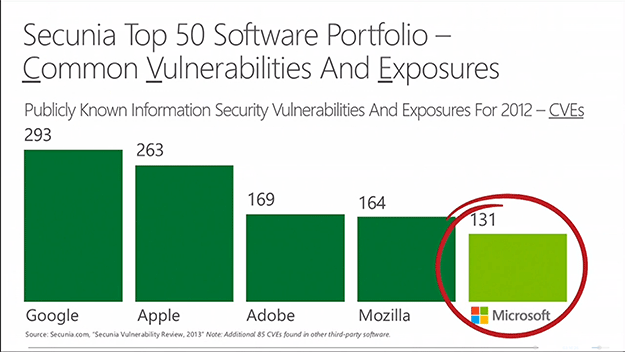
During today’s WPC 2013 Event, Kevin Turner, Chief Operating Officer at Microsoft, boasted about their achievements in the security department and compared the number of vulnerabilities versus Google and Mozilla.
The slide above is pretty self explanatory but if you are wondering where they got these statistics from, it’s from Secunia’s Vulnerability Review 2013 report, which can be requested in the following page.
Continue Reading
Opera’s Internal Network Breached
 Takes one week to notify its users.
Now here is something that is not pleasant for any company or its product(s) users. Opera Software has just informed everyone about a network breach (that was uncovered on June 19th), which has grave consequences for those that were affected.
According to the blog post, attackers have stolen the Opera code signing certificate and used it to sign and distribute some malware distinguished as Opera browser.
Continue Reading
AdLeaks: A Whistleblower Friendly Web Technology

The power of the web.
Now here’s an interesting take on leaking private data. Researchers in Germany are working on a new, ad based platform that would allow whistleblowers to share the information without compromising their positions.
And here is how it works: a web site will embed AdLeaks ad, which contains a code capable of encrypting an empty message with the AdLeaks public key and sending it back to their servers.
Continue Reading
Mozilla Asks Congress, Microsoft And Google To Stop Spying
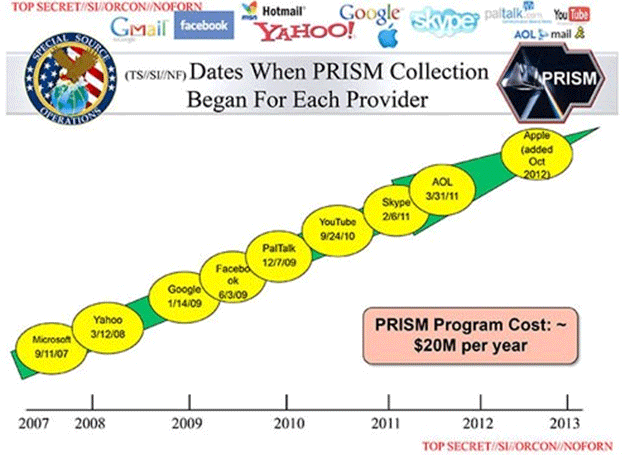
Well, now you know why Google and Microsoft are so eager for you to signup when using their services and what they do with that data.
Fortunately, organizations like Mozilla, Reddit, DuckDuckGo and many more have a better idea and care about your privacy. Thanks to the recently leaked data about PRISM, these companies are asking the Congress to end NSA surveillance.
Continue Reading
Firefox Brand Used To Cover Spyware
 Mozilla isn’t too happy about it.
According to a report by Citizen Lab, Gamma International, a UK based firm that produces surveillance software (FinFisher), is tricking people into installing their spyware on their machines, which is later masked as Firefox.exe.
As noted in the Mozilla’s blog post, “when a user examines the installed spyware on his/her machine by viewing its properties, Gamma misrepresents its program as “Firefox.exe” and includes the properties associated with Firefox along with a version number and copyright and trademark claims attributed to “Firefox and Mozilla Developers.”
Continue Reading
Google Chrome & Firefox Have More Vulnerabilities Than Flash And Java Combined
Time to go back to IE?
Now here is something you won’t hear that often. Despite the common hate for Adobe’s Flash and Oracle’s Java plugins, it looks like they are not the major offenders when it comes to the actual number of vulnerabilities.
According to the latest report by security firm Secunia, Google Chrome, Firefox and iTunes are responsible for the majority of Windows security issues. As it turns out, 86% of all Windows vulnerabilities in 2012 (up from 78% last year) come from non-Microsoft applications and here is the actual list (vulnerabilities – product name):
Continue Reading


